Weekly notes Friday March 27, 2026
Things to read, to watch, resources and more

Here’s a bunch of things I found this week. This is my way of tracking things now - sharing them here.
To Read
Perimeter Books @perimeterbooks
Walking as Embodied Worldmaking: Bodies, Borders, Knowledgescapes (Set Margins, Eindhoven)
A nice day for it. Walking as Embodied Worldmaking: Bodies, Borders, Knowledgescapes (Set Margins, Eindhoven). /// Link to store in bio. /// Edited by Lea Maria Spahn
Walking is as much a cultural practice as it is an embodied experience. The contributions in this book highlight the interrelations between bodies, knowledges, places, affects, and other materialities through phenomenological, artistic, and methodological lenses. Walking is explored as a relational practice situated in specific landscapes – it connects different cultural practices, holds material-semiotic performativity, and always involves an interweaving of (geo)political territories and borders. This book brings together written and visual contributions from social scientists and artists, offering a vibrant and multifaceted perspective on the phenomenon of walking.
Introduction and text by Lea Maria Spahn. Contributions by Ana Anaa, Antonín Brinda, Dorothea Hamilton, Otto Kauppinen, Marie Kammler, Astrid Lembcke-Thiel, Hana Magdoňová, Maja Maksimović, Darija Medić & Mirjana Utvić, Susanne Nemmerz, Eva Clara Tenzler, Shira Wachsmann, Mariele Weber, inka°witz, Regula Pöhl, Daniela Villiger. #perimeterbooks @setmargins
To Read
From Lars Muller Publishers @larsmullerpublishers
these books explore water as a vital resource and a shared responsibility. From melting ice and engineered dams to polluted rivers and fragile ecosystems, they reveal how water connects ecology, politics and human life across a changing world.
“100 Words for Water: A Projective Ecosocial Vocabulary” by Eva Franch i Gilabert, Mireia Luzárraga & Alejandro Muiño (eds.)
Who Owns the Water?” by Lars Müller, Klaus Lanz, Christian Rentsch & René Schwarzenbach (eds.) – English & German editions
“Hydroelectric Sublime” by Beatrice Gorelli & Keiichi Kitayama (eds.)
“The Colors of Growth: China’s Huai River” by Andreas Seibert
“Waters in Between” by Lukas Felzmann
“Antarctic Resolution” by Giulia Foscari / UNLESS (eds.)
To Read
New issue of Ceramics in America is online: https://chipstone.org/issue.php/60/Ceramics-in-America-2025
To Read
https://fs.blog/david-foster-wallace-this-is-water/
From the link above: David Foster Wallace‘s 2005 commencement speech to the graduating class at Kenyon College is a timeless trove of wisdom — right up there with Hunter Thompson on finding your purpose. The speech was made into a thin book titled This Is Water: Some Thoughts, Delivered on a Significant Occasion, about Living a Compassionate Life.
Someone on social media mentioned this, I went looking and it’s a good one to read.
People to read and learn from/with:
Shannon Mattern and Curry J. Hackett delivered a brilliant presentation ( VISITING LECTURE | SHANNON MATTERN AND CURRY HACKETT: MAKING SENSE — SEVEN MOVEMENTS
) this week at The Cooper Union, which I joined via zoom.
Description from lecture link https://cooper.edu/events-and-exhibitions/events/visiting-lecture-shannon-mattern-and-curry-hackett-making-sense-seven :
In this talk Shannon Mattern (
https://wordsinspace.net/
) and Curry Hackett (https://www.wayside.studio/draw ) on their own research and practice to explore a variety of methods for making knowledge material — spatial, experiential, sense-able, manipulable, inhabitable, navigable. Through a call-and-response structure, they’ll examine how actions from cooking and collaging to furniture making to syllabus design help us to make sense of a disordered world.
https://syllabusproject.org/library-field/ - mapping a field.
If you haven’t followed Shannon’s writing on Places Journal here is one place to start:
https://placesjournal.org/article/social-history-of-the-cardboard-box/
Resources
From @centropr
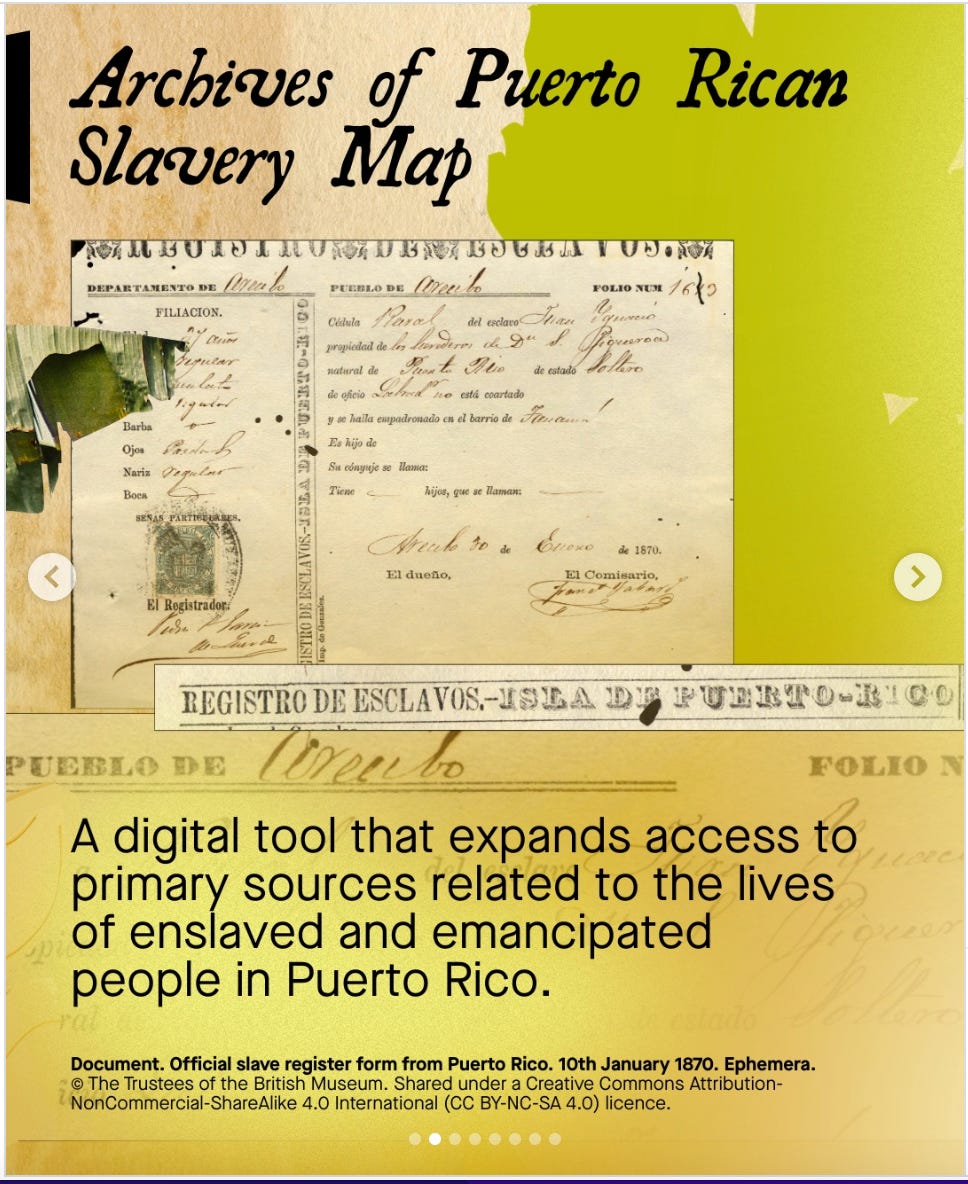
Announcing the Archives of Puerto Rican Slavery Map by Black Puerto Rican Futures
Whether you’re hoping to trace your ancestry, writing a book, or researching the deep history and legacies of Afro-Puerto Ricans, this map is an essential digital tool that expands access to primary sources related to the lives of enslaved and emancipated people in Puerto Rico. Drawing on knowledge developed over years of related research, this living tool brings together information about accessing collections related to the people subjected to slavery and its afterlives in Puerto Rico.
Black Puerto Rican Futures is a three-year initiative that reclaims and restores Black Puerto Rican history of the late nineteenth and early twentieth centuries.
Comment 🗺️on their IG and they’ll send you the link to the Archives of Puerto Rican Slavery Map and to learn more about the Black Puerto Rican Futures Initiative
Resources
I will probably post about this resource more than once. But you should not put off checking it out:
https://blackcraftspeople.org/
I have syllabi on my mind after Shannon Mattern and Curry J. Hackett’s presentation at The Cooper Union. Here is one to add to your lists: https://blackcraftspeople.org/bcda-syllabus/
Resources
This needs to be updated and remains useful, too. Put together by Aram Han Sifuentes, L. Vinebaum, Ishita Sharp and me in 2015. https://www.criticalcraftforum.com/unsettling-coloniality-a-critical-and-radical-fibertextile-bibliography
Resources
From @unsettling_mormonism
To read: Becoming Kin: An Indigenous Call to Unforgetting the Past and Reimagining Our Future
Sharing tips for how to do your unsettling ancestry work.
— If you have some suggestions for how to do unsettling ancestral history work,
— or a suggested reading to help folks understand settler colonialism when reading settler-colonial histories
— leave a comment on their IG
RESOURCE TO SHARE
To Visit
Very curious about this place. Anyone been?
Welcome to north London’s Seed Archives (@seedarchives), a relaxed collection of art, design and books on African and Caribbean heritage, courtesy of photographer Christian Cassiel (@christiancassiel).
Conference
@centrefortextileresearch
Ancient Landscapes of Textile Production - Interdisciplinary Perspectives
27-29 May 2026 University of Copenhagen
The conference is organised by the Independent Reserach Fund Denmark (DFF) project
Textile Resources in Viking Age Landscapes team
https://www.thecrimson.com/article/2026/3/23/peabody-new-data-release/
MUSEUMS AND COLLECTIONS
Harvard Peabody Museum Still Holds 46 Percent of Native American Ancestors, New Data Shows
By Shalini N. Ramchune, Crimson Staff Writer
To Read and Watch
The Lamentations of a Rocking Chair
From the Animation Obsessive’s Substack post: In 1982, Isao Takahata and Hayao Miyazaki were in the United States. They’d come to work with Hollywood on an animated Little Nemo feature. The experience was a frustrating one.
But something good came of it. While in Los Angeles, Takahata went to a screening of The Adolescent (1979), a live-action movie from France. It was touring American theaters as a double bill with an animated short from Canada. Takahata didn’t realize that the short had already won an Oscar earlier in 1982.1
Its title was Crac (1981). Takahata was floored — “completely captivated,” he later said. He had to watch it again, pulling colleagues along.

Notetaking Methods - a constant search and interest off mine
Andrew Harker The Classical Mind on substack (@andrewbharker)
I am always searching for ways to track note taking — here’s one that I came across this week:

Jillian Hess’s substack Notes (@jillianhess) on Susan Sontag’s notebooks

Greg Wheeler of Consider the Ant (@gregwheeler2) sharing Austin Kleon’s (@austinkleon) note taking methods

To learn
Garth Greenwell is offering a close reading course on Alex Chee’s (@querent) Edinburgh
https://www.garthgreenwell.com/class-archive/p/alex-chee-edinburgh
RESOURCE TO SHARE